Analects 2.3 Explained: 6 Lessons on Punishment, Shame and Social Order
This Analects 2.3 explained guide unpacks one of the most direct and powerful comparisons in the entire Analects, laying out exactly why laws and punishments alone cannot build a stable, healthy society.
If you have followed our series so far, you will recognize this as the next step in the argument laid out in our Analects 2.1 and 2.2 explained piece. Chapter 2 opens with the ideal of virtuous rule and the “straight heart” standard. Verse 2.3 puts that ideal side by side with the alternative — rule by decrees and penalties — to show the difference in results.
Confucius says: “Guide them with government decrees, regulate them with punishments, and the people will avoid wrongdoing but have no sense of shame. Guide them with virtue, regulate them with ritual, and they will have a sense of shame and also live in good order.”
On the surface, this sounds like a simple praise of morality over law. But the real insight lies in the two final ideas: inner shame and organic social order.
Table of Contents
What Analects 2.3 Explained About Governance
Most translations render the final character ge (格) as “submit,” “come around,” or “be corrected.” That reading misses the original, concrete meaning of the word.
According to the traditional teaching, ge means structure, order, and proper form — the same sense as the grid lines in a writing notebook or the metrical rules in music. It describes a society that runs smoothly, not because people are forced to comply, but because internal shared standards keep everything in place.
The character chi (耻), shame, is equally important. It is not the humiliation of being publicly shamed by others. It is the quiet, inner feeling of guilt and regret that arises when you know you have done wrong, even if no one sees it.
That is the core difference between the two systems Confucius describes. One system trains people to avoid getting caught. The other system trains people to know right from wrong in their own hearts.
The first produces temporary compliance. The second produces lasting order.
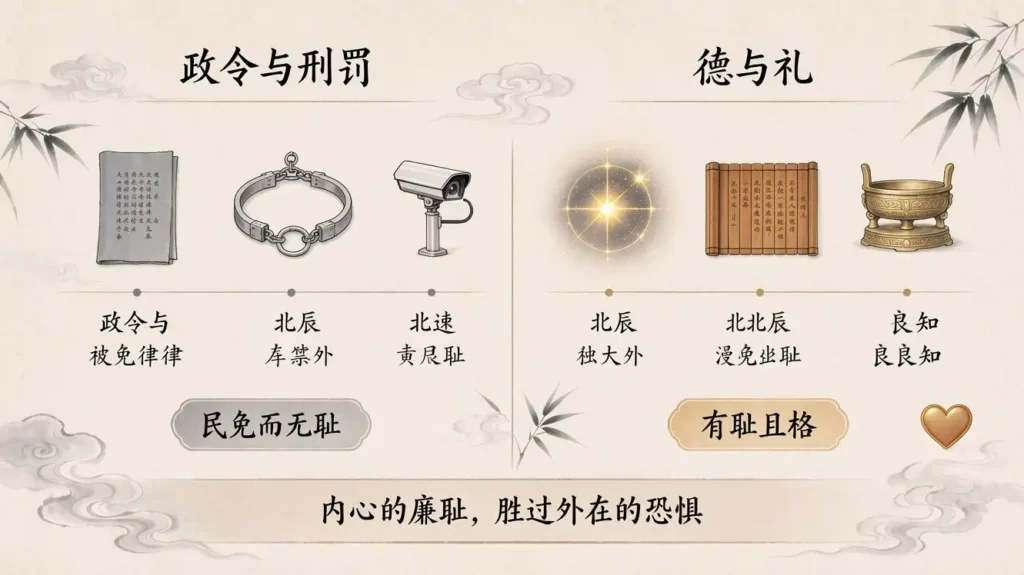
The First Path: Rule by Decrees and Punishments
The first approach Confucius describes is “guide with government, align with punishment.”
This is the most common model of governance throughout history. Rulers issue laws, set penalties, and enforce them. If you break the rule, you suffer the consequences.
This method works, but only up to a very narrow point.
When people are ruled only by fear of punishment, they do not internalize right and wrong. They learn to avoid detection instead. They look for loopholes. They follow the letter of the law while completely ignoring its spirit.
You can see this pattern in everyday modern life. A driver who slows down only at speed cameras does not drive safely because he believes it is the right thing to do. He slows down only to avoid a fine. The moment the camera is gone, he speeds up again.
That is exactly what “avoid punishment but have no shame” means.
People do not feel they have done anything morally wrong. They just feel they were unlucky enough to get caught.
Over time, a society run only by laws and punishments becomes a society of rule-followers and loophole-finders. It never becomes a society of genuinely conscientious people.
The Second Path: Rule by Virtue and Ritual
The second approach is “guide with virtue, align with ritual.”
This is the distinctively Confucian alternative. It does not rely mainly on threats and enforcement. It relies on shared values, shared norms, and shared standards of conduct.
Virtue sets the inner moral standard. Ritual provides the outer social structure.
When people are raised in a culture of ritual and shared moral values, they do not just fear getting in trouble. They feel ashamed when they act badly.
That shame is not imposed from outside by judges or authorities. It comes from inside their own conscience.
And when people have an inner sense of right and wrong, they do not need constant supervision. They regulate themselves.
This is where ge — natural order and proper structure — comes in. A society built on shared values does not need endless rules and layers of enforcers. It develops its own steady, self-sustaining order, because most people want to do the right thing.
The order is not forced from above. It grows from within each person.
Why Inner Shame Beats External Fear Every Time
The difference between these two systems is deeper than most people realize.
Fear is a weak and unreliable motivator. It only works when someone is watching. It only works when the penalty is certain. It disappears the moment supervision is removed.
Shame is a strong and lasting motivator. It works even when no one is watching. It works even when there is no external penalty. It stays with you, because it is tied to your own sense of who you are.
That is why Confucius considered the second system fundamentally superior.
A government that only uses punishment is constantly fighting against people’s worst instincts. It has to enforce every rule, watch every corner, and punish every violation. It is exhausting, expensive, and never fully successful.
A government that builds virtue and ritual is working with people’s better instincts. Over time, people police themselves. The order becomes self-sustaining.
This does not mean Confucius rejected all laws and punishments entirely. He was not a utopian thinker. He simply said that laws and punishments are a lower, weaker form of governance. They are a necessary backup, not the foundation.
Why Analects 2.3 Still Matters for Modern Leadership
This 2,500-year-old teaching is still remarkably relevant today.
It applies not just to national government, but to every kind of leadership: companies, schools, teams, even families.
Many modern organizations run almost entirely on the first model. They make rules, set KPIs, hand out penalties, and try to force compliance through pressure and monitoring.
What they get in return is exactly what Confucius described: people who do the minimum to avoid trouble, who look for loopholes, who have no inner commitment to the purpose of the group.
Leaders who understand the second model do things differently. They build shared values. They set clear norms of conduct. They lead by example, rather than by threat.
What they get in return is a group that regulates itself, that cares about doing things right, that maintains order even when no one is watching.
For a more formal academic exploration of Confucius’ theory of moral order and its influence on Chinese political thought, you can also refer to the Stanford Encyclopedia of Philosophy entry on Confucius.
What This Verse Changes About How You Read the Analects
Reading verse 2.3 carefully also changes how you understand the rest of the Wei Zheng chapter.
Confucius is not just giving random advice about ruling. He is building a complete argument, step by step.
Verse 2.1 states the ideal: virtuous governance draws people naturally, like stars around the North Star. Verse 2.2 defines the inner state that virtue requires: a straight mind, free from depraved thought. Verse 2.3 proves the point by comparing two systems, showing exactly why virtue and ritual work better than decrees and punishments.
Taken together, these three verses form the opening thesis of the entire second book. Good governance does not start with laws. It starts with the character of the person leading.
This is the thread that runs through the whole chapter. Every later teaching about filial piety, about the gentleman, about judging people — all of it comes back to this core idea.
Governance is not a mechanical problem of rules and incentives. It is a moral problem of character and conscience.
Core Concepts of Analects 2.3
| Chinese Term | Pinyin | Common Translation | Original Teaching Meaning |
|---|---|---|---|
| 道之以政 | dǎo zhī yǐ zhèng | Guide with government | Lead people through decrees and administrative rules |
| 齐之以刑 | qí zhī yǐ xíng | Regulate with punishment | Align behavior through penalties and fear of consequences |
| 民免而无耻 | mín miǎn ér wú chǐ | People avoid wrongdoing, no shame | People evade punishment but feel no inner guilt for wrongdoing |
| 道之以德 | dǎo zhī yǐ dé | Guide with virtue | Lead people through moral character and shared values |
| 齐之以礼 | qí zhī yǐ lǐ | Regulate with ritual | Align behavior through shared norms and proper conduct |
| 有耻且格 | yǒu chǐ qiě gé | Have shame and submit | People feel inner shame, and society naturally develops stable, orderly structure |
In the end, Analects 2.3 makes one simple, unshakable point: the strongest social order is never forced from above. It grows from within.
Punishments can stop bad behavior for a day. Shame and shared values can shape how people live for a lifetime.
This is the throughline of the entire Wei Zheng chapter. Good governance is not about having the strictest rules. It is about having the straightest heart — in the leader, and in the people.