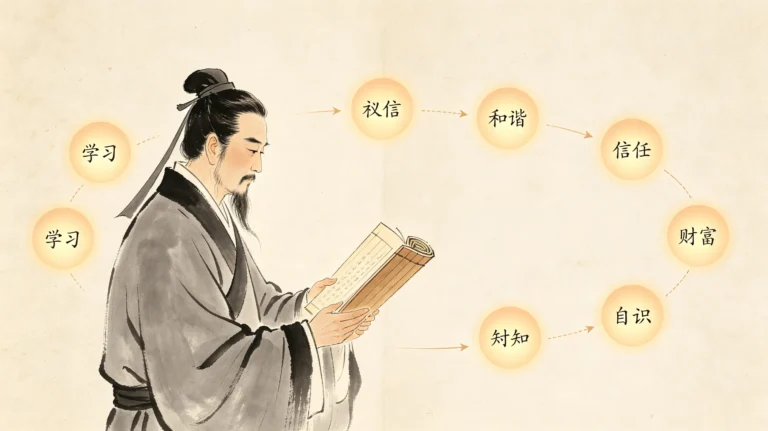
Why Confucius Won Political Trust With the 5 Virtues of Wen Liang Gong Jian Rang
The 5 Confucian virtues of Wen Liang Gong Jian Rang serve as Confucius’ core life principles and the most valuable life wisdom recorded in The Analects 1.10. These timeless virtues shaped his noble personality and extraordinary life pattern. During his decades of travels across ancient Chinese states, Confucius gained sincere trust and respect from monarchs and ministers everywhere. He mastered local political truths without pursuing official power deliberately, becoming one of the most influential sages in the Spring and Autumn Period.
1. Context & Background of The Analects 1.10 Dialogue
For thousands of years, people have misunderstood Confucius’ original intention of traveling across various states. Most people hold a one-sided view that Confucius traveled around and worked tirelessly just to seek official positions and political opportunities. They believe that he failed to realize his political ambitions due to bad luck and finally turned to teaching.
However, the classic dialogue between Ziqin and Zigong in The Analects 1.10 completely corrects this secular misunderstanding. Ziqin was not an official disciple of Confucius. He was more than forty years younger than Confucius, only attended some of his lectures and kept in touch with Confucius’ students. As an outsider observer, his question represents the universal public doubt at that time: did Confucius understand state politics through deliberate pursuit, or purely through personal moral attraction?
This seemingly simple question reveals the essential gap between secular utilitarianism and sage temperament, laying a core foundation for later generations to understand Confucius and Confucian self-cultivation wisdom. Further Reading: 4 Ancient Confucian Education Rules
2. Core Question: Active Pursuit or Virtue Attraction?
Ziqin’s question accurately hits the essence of human nature and social interaction. Whenever Confucius arrived in a new vassal state, he quickly grasped local people’s livelihoods, political advantages and governance defects. Ordinary people would assume that such accurate information acquisition must come from deliberate inquiry and utilitarian efforts.
The truth is totally different. The worldly life logic is always active acquisition and utilitarian exchange: people socialize deliberately for connections, flatter others for opportunities, and compete desperately for discourse power and resources. Confucius’ life logic completely breaks this utilitarian system. He gained everything through moral influence rather than deliberate struggle.
This gap is still obvious in modern life. In the workplace, many people are eager for promotion and salary raises. They blindly flatter superiors and scramble for resources, only to arouse others’ disgust and gain no long-term development. In contrast, people with good conduct, modesty and reliability gain team trust and precious opportunities without deliberate competition. This is exactly the modern embodiment of Confucius’ wisdom of gaining through virtue.
3. Full Definition of 5 Confucian Virtues of Wen Liang Gong Jian Rang
As one of Confucius’ closest disciples, Zigong summarized his teacher’s fundamental principle precisely. Confucius won universal trust and respect purely through the five Confucian virtues of Wen Liang Gong Jian Rang. These five virtues are not empty moral slogans. They form a complete and self-consistent self-cultivation system corresponding to the five core Confucian ethics: benevolence, righteousness, ritual, wisdom, and trustworthiness.
| Virtue | Core Connotation | Corresponding Ethics | Modern Life Cases |
|---|---|---|---|
| Wen | Temperate, lenient and benevolent, forgiving others’ mistakes | Benevolence | Treat colleagues gently, tolerate minor mistakes, build good interpersonal relationships |
| Liang | Upright in conduct, adhere to moral principles and conscience | Righteousness | Stick to professional bottom lines, no speculation or egoistic harm to others |
| Gong | Courteous and respectful to all people regardless of status | Ritual | No flattery to superiors, no arrogance to subordinates, treat everyone equally politely |
| Jian | Simplify trivial learning, abandon superficial knowledge, pursue essential wisdom | Wisdom | Avoid blind knowledge accumulation, focus on core competence and essential growth |
| Rang | Modest and altruistic, share benefits to win sincere trust | Trustworthiness | Avoid competing for credit and profits in teamwork, win long-term respect through sharing |
Most modern people misunderstand “Jian” as material frugality and stinginess. In Confucian philosophy, “Jian” means simplifying redundant learning and reducing superficial obsessions. Modern people often fall into knowledge anxiety, blindly purchasing courses and accumulating fragmented skills without systematic thinking. True “Jian learning” encourages people to discard useless trivial knowledge, focus on essential truths, and gain deeper wisdom through simplification.
The core of “Rang” is altruism and trust building, which represents the highest level of life pattern. In daily life, people who haggle over every ounce and monopolize interests seem to gain temporary advantages, but never win sincere respect. Those who are modest, generous, and willing to share gain lasting reputation, trust, and stable interpersonal resources.
4. Why Confucius’ Pursuit Is Different From Ordinary People
Zigong pointed out the core essence of this chapter. Confucius’ life pursuit was completely different from ordinary people. Most people struggle throughout their lives for fame, wealth, power, and status, with all efforts centered on personal interests and worldly glory.
Confucius never pursued personal official glory or supreme power. He traveled across turbulent states for more than ten years solely to promote ritual morality and benevolent governance. His lifelong goal was national stability, social harmony, people’s well-being, and the ultimate ideal of universal unity for the world.
Thanks to his selfless and pure virtue, monarchs and ministers of all states let down their guard completely. In the turbulent Spring and Autumn Period, power struggles were rampant, and rulers were extremely vigilant against scholars and advisers. However, everyone recognized Confucius’ pure benevolence and selflessness, so they took the initiative to consult him on national governance and share state affairs frankly.
Therefore, Confucius’ thorough understanding of various state politics was never obtained through active inquiry or deliberate pursuit. It was entirely the spiritual influence and natural result of the five Confucian virtues of Wen Liang Gong Jian Rang. When virtue is sufficient, opportunities, connections, and discourse power come naturally. Reference: Wikipedia — The Analects of Confucius
5. Modern Value of the 5 Confucian Virtues of Wen Liang Gong Jian Rang
After more than two thousand years of inheritance and verification, the five Confucian virtues of Wen Liang Gong Jian Rang are still highly applicable to modern workplace competition, social communication, and personal self-improvement. They have become the underlying core logic for ordinary people to break through limitations and achieve long-term success.
In today’s utilitarian and involutionary society, many people fall into the dilemma of “hard work without progress”. They desperately learn skills, expand social connections and compete for resources, but still fail to gain recognition and stable development. The core reason is valuing techniques over morality, having talent but lacking virtue.
In contrast, people who practice the five Confucian virtues behave gently and kindly in social interactions, modestly and rigorously in work, concisely and practically in self-growth, and altruistically in team cooperation. A temperate personality shortens interpersonal distance and resolves conflicts; rigorous and moral conduct accumulates long-term workplace credibility; simplified and essential learning gets rid of invalid involution; modest sharing and altruism win sincere team support.
This virtue-based growth mode has no fast shortcuts, but it is extremely stable and sustainable, becoming lifelong valuable wisdom for modern people.
Conclusion
The Analects 1.10 completely corrects the thousand-year misunderstanding of Confucius and guides modern people on self-cultivation and success. True life wisdom never comes from forced pursuit or utilitarian struggle, but from silent moral cultivation and spiritual influence. The five Confucian virtues of Wen Liang Gong Jian Rang are not only Confucius’ foundation for preaching in turbulent times, but also the ultimate wisdom for modern people to cultivate their minds, handle affairs, and go far in life.