Analects 2.1 and 2.2 Explained: 7 Key Insights Into Virtuous Governance
This Analects 2.1 and 2.2 explained guide breaks down two consecutive verses from Wei Zheng (为政), Chapter 2 of the Analects, to help you understand why Confucius considered “virtuous governance” (为政以德) the foundation of stable leadership and why he summarized the entire Book of Songs in one phrase: “thinking without depravity” (思无邪).
Those who have read our Analects Book 1 Summary: 8 Core Truths From Confucius’ Chapter 1 will already know that the first chapter builds the entire foundation of self-cultivation. Chapter 2 takes that foundation and applies it directly to the question of leadership and government.
Most popular readings treat these two verses as separate moral comments. One praises virtuous rulers, while the other praises pure-minded poetry.
But in the original teaching context, the two verses are closely connected.
Verse 2.1 defines the ideal of “governmental virtue.” Verse 2.2 explains what that virtue actually means at the level of thought and motivation.
When you read them together, Confucius’ political teaching becomes much clearer.
He does not reduce good government to laws, punishments, or clever policies. He reduces it to the quality of the ruler’s mind.
Table of Contents
1. Why Confucius Said “Govern Virtuously”
Confucius begins Chapter 2 with one of the most famous lines in the Analects.
“为政以德” — “Governing through virtue.”
This is not a vague moral compliment. It is a structural claim about how political order works.
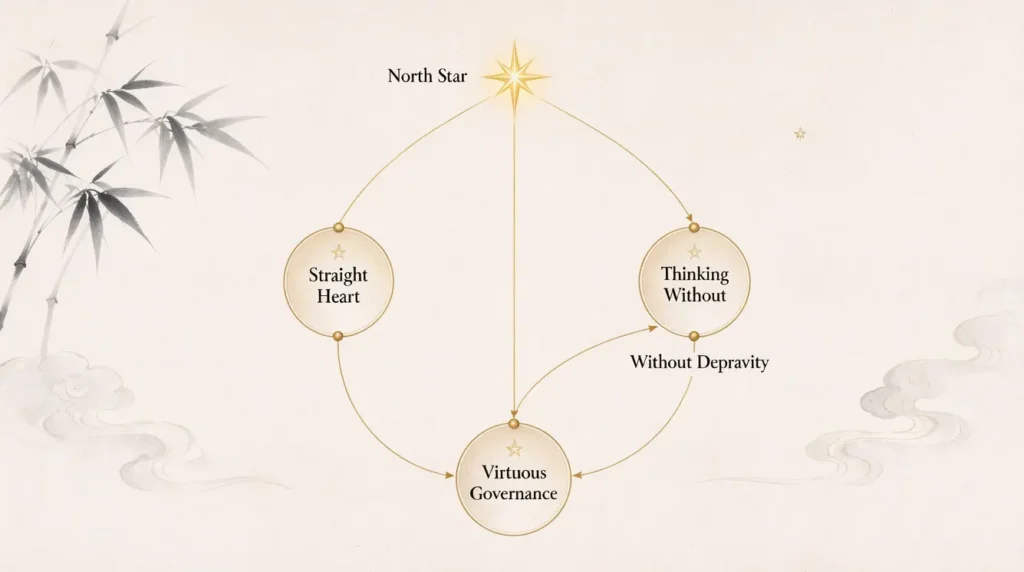
According to the original teaching, the character de (德) itself carries a hidden clue. In early script forms, de was written as zhi (直) plus xin (心), suggesting a meaning close to “straight heart” or “upright mind.”
If the ruler’s heart is straight, his government will be straight.
If the ruler’s heart is crooked, no amount of ritual, law, or propaganda can make the government truly straight.
This is why Confucius compares the virtuous ruler to the North Star.
The North Star does not chase the other stars. It stays in its place, and the other stars turn around it.
A virtuous ruler does not need to bully, bribe, or manipulate people into submission. He simply holds to what is straight, and people naturally orient toward him.
This is the core difference between Confucian political thought and many later theories of power.
Power based on force may produce obedience. Power based on virtue produces allegiance.
2. The North Star Metaphor: Leadership by Example
The North Star metaphor is easy to misunderstand.
Some readers take it to mean that a virtuous ruler will automatically be successful. Others take it to mean that people should blindly obey their ruler.
Neither reading captures Confucius’ real point.
The North Star does not command the other stars. It also does not beg for their attention.
It simply remains stable.
Similarly, the virtuous ruler governs by example rather than by coercion.
He does not lead primarily by threats, rewards, or clever manipulation. He leads by the quality of his own mind and conduct.
When the ruler is straight, officials know what standard to follow. When he is sincere, people learn to trust him. When he is free from selfish scheming, the whole political system becomes less toxic.
This is why the North Star image is so powerful.
Leadership is not mainly about what you do to other people. It is mainly about what you hold steady within yourself.
3. What The Book of Songs Reveals About Virtue
After defining “governmental virtue,” Confucius immediately turns to The Book of Songs.
He says that the three hundred poems of the Songs can be summarized in one phrase:
“思无邪” — “Thinking without depravity.”
At first glance, this seems like a comment on literature. But in the original teaching context, it is actually a comment on virtue itself.
Why?
Because “thinking without depravity” means the mind is free from crooked, selfish, and manipulative thoughts.
That is exactly what “straight heart” means.
So Confucius is not just saying that poetry should be morally clean. He is saying that the highest political virtue can be summarized by the condition of the ruler’s thought.
If the ruler thinks straight, he will govern straight.
If the ruler thinks crookedly, even the most beautiful institutions will eventually become crooked.
This is the hidden bridge between 2.1 and 2.2.
Verse 2.1 describes the result: people gathering around the ruler like stars around the North Star.
Verse 2.2 describes the inner condition that makes that result possible: a mind without depravity.
4. “Thinking Without Depravity” Is Not Censorship
Many modern readers misunderstand “thinking without depravity.”
They assume Confucius is calling for censorship, conformity, or the suppression of human emotion.
That reading is unlikely.
The Book of Songs includes love poems, complaints, laments, praises, and criticisms. It is not a collection of bland moral slogans.
Confucius would not have praised it if he thought literature should be empty of real human feeling.
So “thinking without depravity” must mean something deeper.
It means that the thought behind the words is not twisted by selfishness, hypocrisy, or calculation.
A poem can express strong emotion and still be “without depravity.”
A political speech can sound very elegant and still be full of depravity.
The issue is not whether the language is emotional. The issue is whether the mind behind it is straight.
This is one of the most important insights in the entire Analects.
Morality is not mainly about controlling outward expression. It is about purifying the inner source from which speech and action arise.
5. Why Virtuous Government Is Simpler Than People Think
One surprising implication follows from Confucius’ teaching: good government is actually simpler than many politicians make it.
If the root of political order is the ruler’s mind, then the most important political work is not all complicated.
It is inner work.
The politician who is always scheming, dividing people, manipulating information, and serving private interests may appear clever. But according to Confucius, he is moving further away from real political order.
The virtuous ruler, by contrast, does not need endless tricks.
He needs only one thing: to keep his thought straight and his heart upright.
This does not mean that institutions, laws, and policies are unimportant. It means that they cannot become healthy until the people who run them are healthy.
A crooked mind will twist any institution.
A straight mind will make even ordinary institutions work more honestly.
This is why Confucius’ political teaching is so demanding and so simple at the same time.
It is demanding because it requires the ruler to transform himself.
It is simple because it reduces the problem of government back to one clear question: what kind of person is leading?
For a more formal academic account of Confucius’ political philosophy and its historical influence, you can also refer to the Stanford Encyclopedia of Philosophy entry on Confucius.
6. The Hidden Connection Between Poetry and Leadership
The connection between poetry and leadership may seem strange at first.
Why would Confucius talk about The Book of Songs right after talking about virtuous government?
The answer is that poetry reveals the quality of a person’s thought.
If a person’s thought is crooked, his poetry will eventually show it.
If a ruler’s thought is crooked, his government will eventually show it too.
Poetry is one mirror. Government is another mirror.
Both reflect the condition of the heart.
This is why Confucius valued the Songs so highly. They were not just entertainment or decoration. They were a training ground for the mind.
To read the Songs properly is to learn to distinguish straight thought from crooked thought.
To govern properly is to act from straight thought rather than from crooked thought.
So literature and politics are not separate subjects in Confucius’ view.
They meet at the same point: the quality of the human heart.
7. What This Means for Leaders Today From Analects 2.1 and 2.2 explained
Confucius’ teaching may seem ancient, but it has a surprising amount of relevance today.
Modern politics often focuses on image management, polling, slogans, and tactical maneuvering.
Many leaders act as if government is mainly about winning the next round of competition.
Confucius suggests a completely different standard.
The real measure of good leadership is not how cleverly you defeat opponents.
It is whether your thought is straight enough that people can genuinely trust you.
A leader who is always calculating, always dividing, and always serving private interests may win many battles. But he will lose the one thing that matters most: the inner authority that makes people willingly follow.
That is the difference between power and virtue.
Power can make people obey.
Virtue can make people gather.
Analects 2.1 and 2.2 explained: Key Terms Table
| Chinese Term | Pinyin | Common Translation | Deeper Meaning in These Two Verses |
|---|---|---|---|
| 为政以德 | wèi zhèng yǐ dé | Governing through virtue | Leadership rooted in an upright mind rather than force or tactics |
| 北辰 | běi chén | North Star | The stable center around which people naturally orient |
| 共之 | gòng zhī | To surround / salute | To gather around the leader out of genuine allegiance |
| 诗三百 | shī sān bǎi | The three hundred Songs | The Book of Songs as a mirror of human thought |
| 思无邪 | sī wú xié | Thinking without depravity | Straight thought, free from crooked and selfish calculation |
| 德 | dé | Virtue | In early script forms, close to “straight heart”; the inner source of good governance |
Taken together, these two opening verses of Wei Zheng set the tone for the entire second book of the Analects.
Confucius never reduces good governance to systems, tactics, or punishment. He traces every political outcome back to the inner state of the person in charge.
A straight mind produces straight government. A crooked mind produces crooked rule.
This ancient teaching holds just as true today, for leaders, teams, families, and individuals alike. You do not need a title to practice virtue. You only need to keep your own thought upright — and the rest will follow.