
Analects Book 1 Summary: 8 Core Truths From Confucius’ Chapter 1 (All 16 Verses)
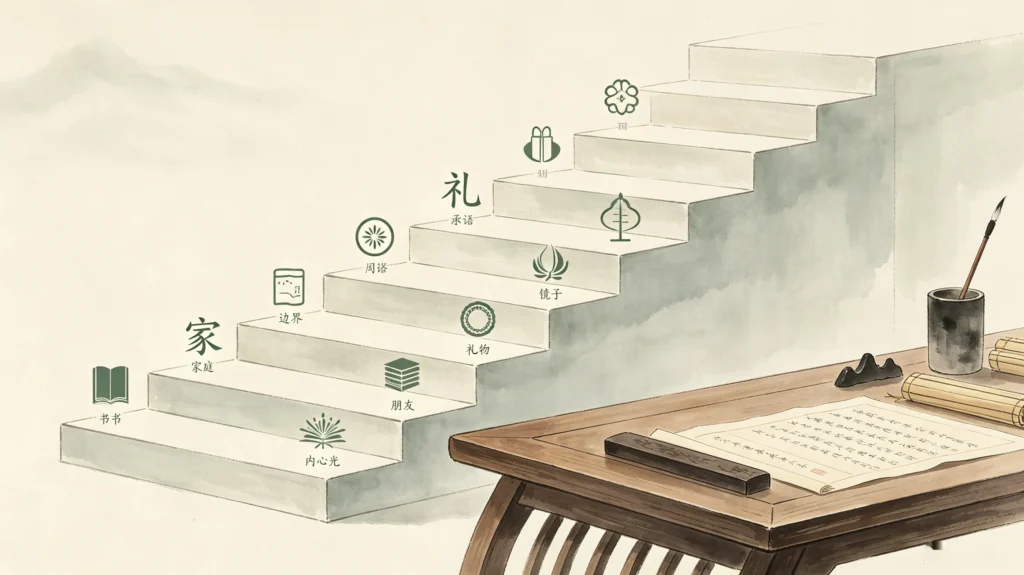
This Analects Book 1 summary is compiled directly from the original lecture transcript, correcting four long-standing misinterpretations of the Analects — habitual misreading, taking verses out of context, misguidance from established authorities, and limited insight into the original meaning of characters — to reveal the complete framework of self-cultivation laid out in the 16 verses of the first chapter.
Many readers approach the Xue Er chapter as a loose collection of moral maxims, either as self-help platitudes or as feudal ethical rules. In reality, the entire first chapter is a structured, step-by-step curriculum for beginners on the path of self-cultivation. It begins by redefining what “learning” really is, then moves through the starting point of practice, daily work, standards for conduct, and the core of transmission, and finally arrives at the freedom of self-knowledge.
Every verse has its place. Every line carries deep meaning. Most popular translations have lost sight of the original core.
Table of Contents
1. The Opening Thesis: Learning Is Cultivation, Practice Is Awakening
The very first line of the Analects has been mistranslated by almost every popular edition.
“Xue er shi xi zhi, bu yi shuo hu” is almost universally rendered as “To learn and review what you have learned, is that not a pleasure?” But this completely misses Confucius’ original intent.
Here, xue (学) does not mean book learning or academic study. It refers to the lifelong process of self-cultivation. Daoists call this “cultivating reality”; Confucians call it “cultivating the person.” Confucius captures the whole path in this single character.
Xi (习) does not mean review or routine practice. Confucius borrows the imagery of “a gentle breeze blowing” to describe the sudden, refreshing rush of insight that arises in cultivation — the moment of awakening, of sudden realization.
Shi (时) means the instant, the split second. “Shi xi” refers to that moment of sudden awakening along the path.
So the true meaning of the opening line is: To walk the path of self-cultivation, and to experience that moment of sudden awakening — is that not the truest joy?
The second line, “You peng zi yuan fang lai, bu yi le hu”, also does not refer to physical friends.
The peng (朋) here is your own inner wisdom, your intrinsic nature. You have never seen it before. At a certain stage of cultivation, it suddenly manifests, like an old friend arriving from far away. That is why le (joy) is a deeper, fuller form of happiness than shuo (delight) — it is the sustained joy of wisdom continuously unfolding.
The third line, “Ren bu zhi er bu yun, bu yi junzi hu”, is also usually read too shallowly.
Zhi (知) is a phonetic loan for zhi (执), meaning attachment. Yun (愠) is a phonetic loan for yun (蕴), meaning to take something to heart, to hold it inside.
When others do not understand you or recognize you, you do not take it to heart. You do not cling to external validation. That is the mark of a junzi (noble person). The junzi and the petty person do not even operate on the same level. It is not a matter of anger — it is simply that they do not walk the same path.
These three lines form the core thesis of the entire Analects: The first speaks of cultivation and awakening. The second speaks of the manifestation of wisdom. The third speaks of the state of the noble person.
The opening passage already lays out the purpose of human life, the goal of cultivation, and the definition of the junzi.
2. The Starting Point of Cultivation: Begin With Filial Piety and Daily Life
After laying out the core thesis, Confucius immediately tells us where to start: with the people closest to you.
Master You says: “Filial piety and fraternal respect are the starting point of ren (benevolence).” Note that the word “root” here means starting point, point of entry — not the ultimate foundation. A tall building starts from the ground floor, but the ground floor is not the peak.
Xiao (filial piety) is directed toward parents; ti (fraternal respect) toward siblings. The first people you encounter in life are your family. Learning respect, consideration, and boundaries here is the first step of cultivation.
This is made even clearer in verse 1.6: “A young person, at home, is filial; abroad, is respectful to elders; cautious and trustworthy; broadly kind to all, and draws close to those who are ren. If after doing all this he has energy left, he may study culture.”
Moral conduct comes first. Book learning comes second. If the order is reversed — if a person has culture but no character — it is like the old saying: “A scoundrel with education is far more dangerous than a scoundrel without.”
Verse 1.7, from Zixia, drives this standard home: If a person respects the worthy, serves his parents with full effort, serves his master with full devotion, and keeps his word with friends, then even if people say he has never studied, I would say he has wisdom. He is already cultivating.
An important note here: “serving the lord” does not mean serving a feudal ruler. Jun (君) here means the noble person, the spiritual teacher, the guide on the path of cultivation. Later corrupt Confucian scholars twisted this into the doctrine of absolute loyalty to the emperor, which is a complete distortion of Confucius’ original meaning.
3. The First Test: True Virtue vs. Clever Performance
The first checkpoint on the path is telling the difference between genuine virtue and performance.
Confucius puts it bluntly in verse 1.3: “Clever words and a contrived countenance — rarely have they anything to do with true benevolence.”
Why? Because true ren grows from within. It is not performed for an audience. People who excel at pretty words and pleasing expressions are putting on a moral show. Their goal is to flatter, to gain advantage, to win approval — the opposite of true cultivation.
This is a warning for all beginners: Do not indulge in listening to sweet words. Do not become the person who only says nice things. The more polished the performance, the further it usually is from the way.
True virtue is quiet. It shows in action, not on the face or the tongue.
4. Daily Practice: Three Daily Reflections and Self-Correction
Cultivation is not sitting in meditation or retreating to the mountains. It is the small, daily work of polishing yourself.
The classic daily practice comes from Master Zeng in verse 1.4: “Every day I examine myself on three points.”
- When acting for others, have I done so without full devotion?
- In dealings with friends, have I been untrustworthy?
- What has been transmitted to me, have I truly awakened to it?
Notice the third point: “Have I practiced what was transmitted?” The word xi here is the same as in the opening line — it means awakening, realization, not rote review. Have you actually embodied the wisdom passed down to you? Have you made it your own?
That is the daily work: not judging others, but questioning yourself.
Verse 1.8 adds four more practical guidelines for daily life: “If the noble person is not self-respecting, he will have no authority; his learning will not take root. Hold loyalty and trust as primary. Do not make friends with those who are not your equal in character. If you make a mistake, do not be afraid to correct it.”
“Zhong” (重) means self-discipline, not mere solemnity. A person who can discipline himself has inner strength, and his learning takes firm root.
“Do not make friends with those not like you” does not mean you should only be friends with people better than you. It means do not look down on anyone; always look for the good in others. The core standard for friendship is loyalty and trust. Do not fixate on small flaws in others. And when you see your own faults, do not hesitate to change. That is real cultivation.
5. Governance: Authority Grows From Virtue, Not Tactics
When the Xue Er chapter speaks of governance, it is nothing like later theories of power and statecraft.
In verse 1.5, Confucius says: “In guiding a state of a thousand chariots, be respectful in affairs and trustworthy; be frugal in expenditure and love the people; employ the people at the proper season.”
“Dao” (道) here means to guide, to lead. Governing a large state does not depend on laws, systems, or power plays. It depends on four things: Respectful attention to duty, trustworthiness with the people, frugality with resources, care for the population, and timing the use of public labor so it does not disrupt livelihoods.
The same principle applies today: running a company or leading a team cannot be only about extraction, overtime, and exploitation. Treating people as tools always breaks down eventually.
The exchange between Ziqin and Zigong in verse 1.10 reveals even more about Confucius’ approach to governance.
Ziqin asks: When the Master arrives in a state, he always learns about its government. Does he seek this information, or is it given to him?
Zigong answers: The Master obtains it through warmth, goodness, respect, frugality, and deference.
These five qualities correspond to the five virtues: Warmth = benevolence Goodness = righteousness Respect = ritual propriety Frugality = wisdom Deference = trustworthiness
Confucius does not chase power, information, or position. He receives them naturally, because of his character. People trust him, so they tell him things. People respect him, so they listen to him.
This is the core Confucian logic of leadership: authority is not seized. It emerges naturally from virtue.
6. Transmission: Reverence for the Way and True Filial Piety
Most misunderstandings of Confucian “filial piety” center on family obedience and parental authority. But in the Xue Er chapter, xiao has a deeper meaning: the transmission of the way.
In verse 1.9, Master Zeng says: “Treat the end with care, continue the sacrifices to the distant ancestors — and the people’s virtue will grow thick.”
This is not feudal superstition. It is about cultivating reverence and depth of feeling through ritual. When a culture honors its roots, its people naturally become steadier, kinder, and more serious.
The most commonly misread verse is 1.11: “When the father is alive, observe his will. When the father is gone, observe his conduct. If for three years he does not change from the way of his father, he may be called filial.”
The word “fu” (父) here does not mean biological father. It means master, teacher.
While your teacher is with you, observe your own aspiration. When the teacher is no longer beside you, observe your own actions. If for years you do not deviate from the path your teacher set before you, that is true filial piety — filial piety in the sense of dharma transmission.
The character for xiao (孝) is made of half “old” above “child” — originally meaning the disciple carries on the lineage of the master. Later corrupt scholars forced a narrow biological interpretation onto this verse, turning it into a doctrine of absolute parental authority. That is a complete departure from Confucius’ original intent.
True transmission is not obeying your parents’ every word. It is not betraying the way, the teacher, and the vow you once made.
7. Standards of Conduct: Ritual Borders and Righteous Trust
There are two core standards for dealing with others: ritual and trust.
In verse 1.12, Master You says: “In the practice of ritual, harmony is the most precious thing.” But the next line is the real point: “If you seek harmony for harmony’s sake, without regulating it by ritual, it will not work.”
Most people only remember the first half. They think Confucianism teaches endless compromise, compliance, and keeping the peace at any cost.
This is wrong. What Confucius really teaches is this: harmony is precious, but it can only exist when bounded by shared standards and boundaries.
Harmony without principle is fake peace. Conflict avoidance without boundaries builds up resentment underneath. It always breaks down eventually. When principles matter, they must be stated. Surface harmony is not worth more than real respect.
Verse 1.13 continues with the standard for trust: “Trustworthiness close to righteousness — then your words can be fulfilled.”
A promise only deserves to be kept if it aligns with moral standards. Keeping your word no matter what is not virtue — it is stubbornness.
The story of Wei Sheng holding the pillar and drowning rather than breaking an appointment is the classic example of foolish loyalty, not integrity. Confucius himself once broke an oath made under duress, because a promise extracted by threat has no moral weight.
The same applies to respect: “Respect close to ritual — then you stay far from shame.” Respect must follow proper form. Bowing to the wrong people, in the wrong context, is not humility — it is self-debasement.
The final principle is: “Abide by what is caring for people, and you will have a guiding standard.” All trust and all ritual must be rooted in care for people. That is the ultimate purpose of li and yi — not rules for their own sake.
8. The Final Destination: Wealth as Flow, Freedom as Self-Knowledge
The last three verses of the Xue Er chapter reveal the ultimate fruits of cultivation: a true understanding of wealth, and a true understanding of the self.
In verse 1.14, Confucius once again defines what “loving learning” really means: “The noble person does not seek fullness in food or comfort in dwelling. He is diligent in action and cautious in speech. He aligns with the way and corrects himself. This may be called loving learning.”
Cultivation is not meditation, fasting, or pilgrimages. The great way is simple. It is in how you eat, how you live, how you act, how you speak.
The exchange between Zigong and Confucius in verse 1.15 completely overturns common ideas about wealth and poverty.
Zigong asks: “Poor but not fawning, rich but not arrogant — how is that?” Confucius says: “Acceptable. But not as good as poor yet joyful, rich yet fond of ritual.”
The key lies in the character pin (贫). It is composed of “divide” above “cowrie shell (money)”. Literally, it means to distribute money, to give, to be generous.
So “poor yet joyful” is not about being happy despite having nothing. It is about the joy of giving freely, of generosity. That joy comes from within.
“Rich yet fond of ritual” is not just about being polite when wealthy. It is about using wealth to uphold the way, to benefit others — to prosper and then benefit the world.
Wealth is not measured by how much you accumulate. It is measured by how much flows through you. The person who spends is the rich one. The person who only takes is the poor one. Hoarding more does not make you richer. Giving more does.
The chapter closes with verse 1.16: “Do not worry that others do not know you. Worry that you do not know others.”
Do not be anxious that others do not recognize you. The real concern is whether you understand others — and whether you understand yourself.
Knowing others is a kind of cleverness, an observation of surfaces. It has its limits. Knowing yourself is true wisdom: seeing your own motives, your own attachments, your own blind spots.
He who knows others may not know himself. He who truly knows himself will also understand human nature. Someone with genuine self-knowledge does not care at all whether others know him. He has his own inner standard.
This is the final destination of the first chapter: It begins with cultivation. It ends with self-knowledge. Outward, you understand the world. Inward, you understand yourself. When you arrive here, you are a junzi.
Core Truths of Analects Book 1 (All 16 Verses)
表格
| Verse | Common Popular Misunderstanding | True Meaning According to Confucius |
|---|---|---|
| 1.1 | Studying and reviewing brings joy; friends visiting brings happiness | Cultivation brings awakening joy; inner wisdom manifests as deep delight; non-attachment to opinion is noble |
| 1.2 | Filial piety is the root of all benevolence | Filial piety is the starting point, the first step of cultivation |
| 1.3 | Smooth talkers lack kindness | Moral performance and clever words run counter to true virtue |
| 1.4 | Reflect on yourself three times a day | Examine your devotion, trust, and actual awakening — not just memory |
| 1.5 | Governing requires frugality and love for people | Governance grows from virtue and character, not power or tactics |
| 1.6 | Learn morals first, then culture | Character is the foundation; skill without virtue is dangerous |
| 1.7 | Uneducated people can still be learned | Right conduct is wisdom and real cultivation, regardless of schooling |
| 1.8 | Make friends only with people better than you | Look for the good in everyone; friendship is built on loyalty and trust |
| 1.9 | Honoring ancestors makes people virtuous | Ritual reverence cultivates depth and steadiness of character |
| 1.10 | Confucius traveled seeking official position | Confucius’ character naturally attracted trust and information |
| 1.11 | Three years of obedience to father = filial piety | Upholding the teacher’s way and vow = true transmission of the path |
| 1.12 | Harmony is the highest value | Harmony must be built on ritual boundaries; fake peace does not last |
| 1.13 | Always keep your word = integrity | Promises only matter if they align with righteousness |
| 1.14 | Not seeking comfort = love of learning | Self-correction in daily life is true cultivation and true learning |
| 1.15 | Be dignified when poor, humble when rich | Poverty can mean generosity; wealth should serve the way and others |
| 1.16 | Don’t mind if others don’t know you | Don’t cling to recognition; know others, but above all know yourself |
Further Reading
For a deeper look at the final verse of Book 1, read our full interpretation: Analects 1.16: Knowing Others and Knowing Yourself
Note: The interpretation above is compiled from original lecture transcripts, aiming to restore the original meaning of Confucius as distorted by later generations. For a more traditional academic commentary, see the Stanford Encyclopedia of Philosophy entry on Confucius.
