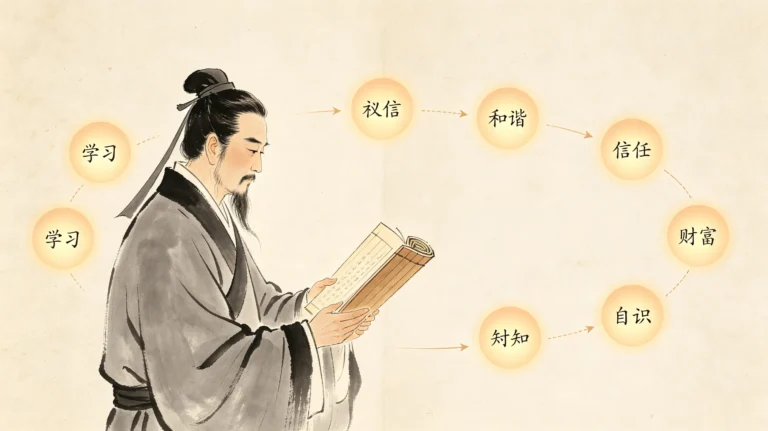
Analects 1.16: 5 Things Confucius Wants You to Understand About Self-Knowledge
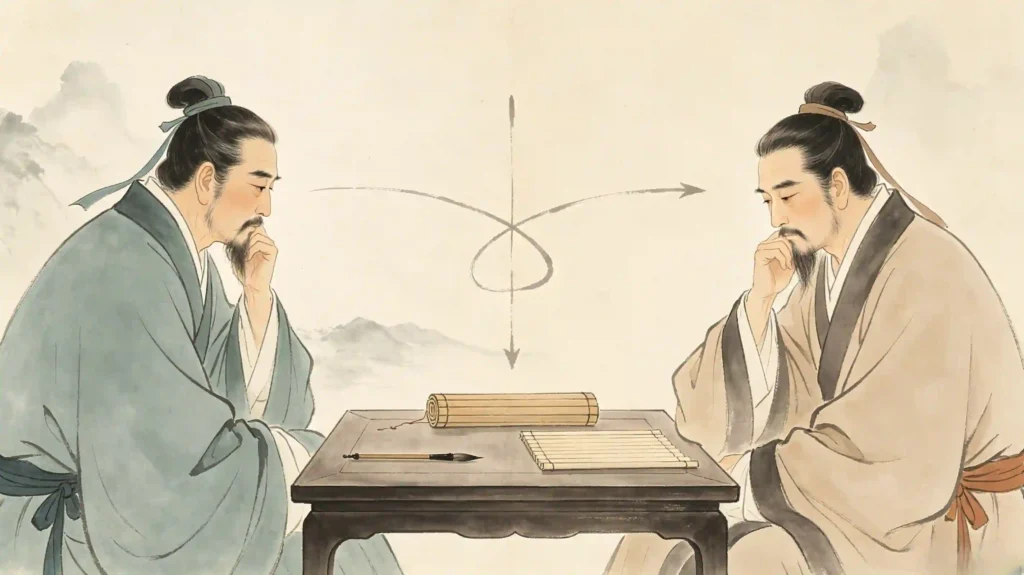
Analects 1.16 is one of the most powerful lines in the entire Analects, and it is also one of the easiest to misunderstand. The focus keyword, Analects 1.16 interpretation, leads us not only to a translation but to a deeper teaching about self-knowledge, other-knowledge, and the difference between surface intelligence and genuine clarity.
Confucius says: “Do not worry about others not knowing you; worry about not knowing others.”
On the surface, this sounds like a simple piece of moral advice. Do not be too concerned with reputation. Do not keep asking why people do not appreciate you. Instead, focus on understanding the people around you.
That reading is not wrong. But it is incomplete.
Table of Contents
The real power of Analects 1.16 appears when we compare it with Laozi’s famous saying: “He who knows others is intelligent; he who knows himself is enlightened.” This connection helps us see that Confucius’ line is not only about social awareness. It is about the hierarchy of wisdom.
Knowing others belongs to a lower level. Knowing oneself belongs to a higher level. And once a person truly knows himself, he no longer needs to worry whether others know him.
This interpretation makes Analects 1.16 much more than a lesson about modesty. It becomes a teaching about inner certainty, moral independence, and genuine self-cultivation.
The Surface Meaning of Analects 1.16
The surface meaning of Analects 1.16 is clear enough.
Confucius tells his students not to be anxious about being unnoticed or unappreciated. Many people spend their lives trying to be seen, recognized, and praised. They want others to know their talent, their effort, and their worth.
Confucius turns this concern upside down.
He says the real problem is not that others fail to know you. The real problem is that you may fail to know others.
This is an important correction for anyone who feels misunderstood.
If you are always saying, “You don’t understand me,” you are probably focusing on the wrong question. The better question is: “Do I understand the people around me? Do I understand their motives, their circumstances, their strengths, and their weaknesses?”
From Confucius’ point of view, being unknown is not a failure. Not knowing others is the real failure.
This does not mean that recognition is unimportant in every sense. A teacher, a leader, or a business person may need to be known in order to act. But in moral cultivation, being known should never be the main goal.
The Analects consistently suggests that a person of virtue should care more about becoming worthy of being known than about being known itself.
Why Worry About Not Knowing Others?
Why does Confucius put so much emphasis on knowing others?
Because human life is lived in relationship. You cannot be a gentleman, a good ruler, a good friend, or a good family member if you do not understand the people with whom you interact.
Knowing others means more than recognizing their faces or remembering their names. It means understanding their character, their intentions, their emotional states, and their moral limits.
If you lack this understanding, you will make many mistakes.
You may trust the wrong person. You may misjudge someone’s motive. You may give praise where it should not be given, or criticize someone without seeing the full picture. You may also create unnecessary conflict because you assume others think exactly as you do.
Confucius is therefore asking the learner to move beyond self-concern.
Instead of asking, “What do others think of me?” ask, “What do I think of others? And do I understand them correctly?”
This shift is already a major step in moral growth. Many people never achieve it. They remain trapped in their own perspective, always waiting for others to change, to see them clearly, or to give them the recognition they believe they deserve.
For Confucius, that is a small-minded way to live.
A much larger life begins when you become curious about other people, not merely as audience members for your own story, but as real human beings with their own struggles and realities.
The Deeper Meaning: “Knowing Others” and “Knowing Yourself”
The surface reading of Analects 1.16 is useful, but it is not the deepest reading. To go further, we must connect it to the famous line from the Daodejing: “He who knows others is intelligent; he who knows himself is enlightened.”
This line helps us see two levels of wisdom.
The first level is knowing others. This is a kind of intelligence. It is useful. It helps you judge people, make decisions, and navigate social life. But it is still outer-oriented.
The second level is knowing yourself. This is not merely another kind of intelligence. It is clarity, illumination, and self-mastery.
According to the traditional understanding developed in our discussion, “knowing others” belongs to the level of worldly intelligence. It is based on observation, experience, and mental discrimination. It can be very sharp, but it is also limited.
“Knowing yourself” belongs to a deeper level of awareness. It is not just about knowing your own personality traits or your own resume. It is about seeing your own motives, your own attachments, your own blind spots, and your own inner nature.
This is much harder than knowing others.
Why? Because when you look at other people, you can at least see some of their behavior. When you look at yourself, there is no independent observer standing outside you. You are both the observer and the observed. You can easily deceive yourself.
For this reason, self-knowledge is considered higher than other-knowledge.
If you know others but do not know yourself, your intelligence remains superficial. You may be clever, but you are not truly enlightened. If you know yourself, however, you gain access to a deeper clarity that also helps you understand human nature itself.
This is why the teaching says: the person who truly knows himself does not need to worry whether others know him.
He already has the most important form of knowledge.
Why the Person Who Knows Himself No Longer Cares About Being Unknown
Once self-knowledge becomes real, the need for external recognition begins to lose its power.
This does not mean the self-aware person becomes completely indifferent to other people. It means he no longer depends on others’ opinions to establish his own worth.
Most people live in a state of inner uncertainty. They want others to know them because they themselves do not yet have a stable grasp of who they are.
If your self-esteem comes from outside, you will always be vulnerable. One person’s praise will lift you up. Another person’s criticism will break you. Your identity will bounce back and forth according to what other people say.
The person who knows himself is different.
He has an inner standard. He understands his own strengths and limits. He knows what he is doing and why he is doing it. For that reason, he is not overly disturbed when others fail to recognize him.
This is not arrogance. It is inner certainty.
Confucius is not saying that other people’s opinions should be ignored completely. A gentleman should listen to feedback, correct his faults, and respect the views of others. But he should not make external recognition the foundation of his life.
The highest form of independence is not independence from other people. It is independence from the need to be constantly validated by them.
When you truly know yourself, being unknown is no longer a source of anxiety. You may still want to be understood for practical reasons. You may still hope that people will recognize your sincerity or your effort. But you will not collapse inwardly if they do not.
That is the freedom Confucius is pointing toward.
The Relationship Between Self-Knowledge and Other-Knowledge
One question often arises at this point. If self-knowledge is so important, why does Confucius tell us to worry about not knowing others?
Is he contradicting himself?
The answer is that knowing oneself and knowing others are not opposed. They are connected.
According to the teaching we are exploring, “knowing others” is a lower form of intelligence, while “knowing yourself” is higher clarity. But the two are not separate.
A person who knows himself will also understand human nature more deeply. He will see how greed, fear, pride, loyalty, shame, and compassion operate in human life. Because he has observed these forces within himself, he will recognize them more accurately in others.
This is why the traditional teaching says: “He who knows others is not necessarily the one who knows himself. But he who truly knows himself will also know others.”
The logic is simple.
If you have never seen your own anger, it is easy to mistake another person’s anger for simple cruelty. If you have never seen your own fear, it is easy to mistake another person’s caution for cowardice. If you have never seen your own pride, it is easy to see pride everywhere except in yourself.
Self-knowledge removes the blind spots that distort your perception of other people.
This does not mean that self-knowledge automatically gives you perfect knowledge of everyone. It means it gives you a much better starting point. You will be less likely to project your own unacknowledged faults onto others. You will be more likely to see people as they are, rather than as you want them to be or fear them to be.
In this sense, self-knowledge is the foundation of accurate moral judgment.
A Practical Reading of Analects 1.16 for Modern Life
Analects 1.16 is not merely a historical text. It has direct practical value for modern readers.
One of the biggest problems in contemporary life is that people are constantly performing for others. They want to be seen, liked, followed, and admired. They measure their value by how many people know their name, how many likes they receive, or how visible they are in their industry.
Confucius would say that this is a very small way to measure success.
True success is not how many people know you. It is how well you know yourself and how accurately you understand the people around you.
This has clear implications for work, leadership, friendship, and family life.
At work, many people want to be noticed immediately. They want their boss to know their contribution, their colleagues to respect them, and their industry to recognize them. But Confucius would ask a different question: do you truly understand your boss’s priorities? Do you understand your colleagues’ pressures? Do you understand the real needs of the people you serve?
If you understand these things, recognition will often follow. Even if it does not, you will still have become more competent and more mature.
In leadership, the same principle applies. A leader who only cares about being known will often perform for the audience. A leader who cares about knowing others will study people, place them correctly, and help them grow.
In personal relationships, the principle is even more important. Many arguments happen because one person feels misunderstood. But Confucius would ask: are you also making an effort to understand the other person?
Being understood is a nice feeling. But understanding others is the real moral achievement.
Why This Line Is Easy to Misunderstand
Analects 1.16 seems simple, but it can be misunderstood in at least two ways.
First, some people read it as a recommendation to be passive. They think Confucius is saying: do not care about anything, do not try to improve your reputation, and accept being invisible forever.
That is not what he means.
Confucius is not advising passivity. He is advising the right priority. It is fine to want recognition if it helps you do good work. But it should never be your main goal.
Second, some people read the line as if knowing others is the final goal. They think Confucius is teaching political cleverness or social manipulation.
That is also a misunderstanding.
Confucius is not teaching people how to manipulate others. He is teaching them how to judge others fairly, how to act appropriately, and how to cultivate virtue in relationship.
The ultimate goal is not to gain power over others. The ultimate goal is to become a better person yourself.
This is why the deeper reading connects Analects 1.16 to self-knowledge. If you only learn to read people without learning to read yourself, you may become clever, but you will not become wise.
Analects 1.16 and the Difference Between Cleverness and Wisdom
The distinction between “knowing others” and “knowing yourself” helps us understand the difference between cleverness and wisdom.
Cleverness is often outwardly focused. It observes other people, analyzes situations, and finds practical solutions. Wisdom is more inwardly rooted. It sees the hidden motives, the inner contradictions, and the deeper structure of human nature.
According to the traditional teaching, “knowing others” belongs to worldly intelligence. It can be very useful, but it is not the highest form of understanding.
“Knowing yourself” belongs to genuine wisdom. It is the foundation of moral clarity.
This is why Confucian self-cultivation always begins with reflection. You cannot become a better person if you are not willing to look inward.
Many modern people want the appearance of wisdom without the work of self-reflection. They read books, collect ideas, and speak confidently about philosophy. But if they never examine their own motives, their knowledge remains external.
Real wisdom starts from the inside.
A Direct Comparison: Two Levels of Understanding
| Level | Description | Result |
|---|---|---|
| Knowing others | Observation of people’s behavior, motives, and circumstances | Useful social intelligence; practical judgment |
| Knowing yourself | Clarity about your own motives, blind spots, strengths, and limits | Inner certainty; moral independence; deeper understanding of human nature |
This table helps make the teaching clear.
The first level is useful. The second level is transformative.
You should not ignore the first level. A gentleman needs to understand people. But you should never stop at the first level. If you do, your intelligence will remain superficial.
The highest achievement is to know yourself so deeply that you no longer depend on other people’s opinions for your sense of worth.
How to Practice the Teaching of Analects 1.16
The teaching of Analects 1.16 can be put into practice in ordinary daily life. It does not require retreating to a mountain or performing complicated rituals.
Here are five practical steps.
First, reduce the complaint that others do not understand you. When you feel this complaint arising, pause and ask whether you have made a genuine effort to understand the other person.
Second, practice observing people without immediate judgment. Notice their circumstances, their fears, their loyalties, and their pressures. Try to see the whole person rather than only the part that affects you.
Third, practice self-reflection every day. Ask yourself what your real motive was in a recent decision. Ask whether you were acting out of principle or out of pride, fear, or the desire for recognition.
Fourth, stop measuring your value by external visibility. It is fine to want to be successful, but do not make being known the definition of success.
Fifth, treat feedback as information, not as an attack. If others criticize you, do not become defensive immediately. Ask whether there is any truth in what they are saying.
These practices are not separate from Confucian learning. They are exactly what Confucius means by self-cultivation.
Conclusion
Analects 1.16 is much deeper than it first appears.
On the surface, it tells us not to worry about being unknown, but to worry about not knowing others. At a deeper level, it tells us that self-knowledge is higher than other-knowledge, and that genuine inner clarity makes external recognition less important.
This reading is supported by the comparison with Laozi’s line about knowing others and knowing yourself. While the two texts should not be merged mechanically, they illuminate each other.
The greatest freedom Analects 1.16 offers is freedom from the constant need to be seen. When you truly know yourself, you become less dependent on other people’s opinions. When you truly understand human nature, you become more capable of judging people fairly and acting appropriately.
This is not merely intellectual knowledge. It is practical wisdom.
If you want to explore Confucian teachings further, you can read our previous interpretation of Analects 1.15, which focuses on wealth, giving, and character. For a more academic perspective, see the Stanford Encyclopedia of Philosophy entry on Confucius.