Analects 1.2 Explained: 5 Insights Why Master You Zi Calls Filial Piety the Starting Point of Virtue
Analects 1.2 Explained: 5 Insights Why Master You Zi Calls Filial Piety the Starting Point of Virtue offers a profound look into the practical “entry point” of spiritual and moral cultivation.
While the first chapter of the Analects dealt with the inner awakening of a Junzi, this second section moves toward the foundation of human conduct. Master You Zi, a disciple who famously resembled Confucius in appearance, shifts the focus from the “Satori” of the mind to the “Root” of our daily interactions within the family.
1. Analects 1.2 Explained: Who is Master You Zi and What is “Ben”?
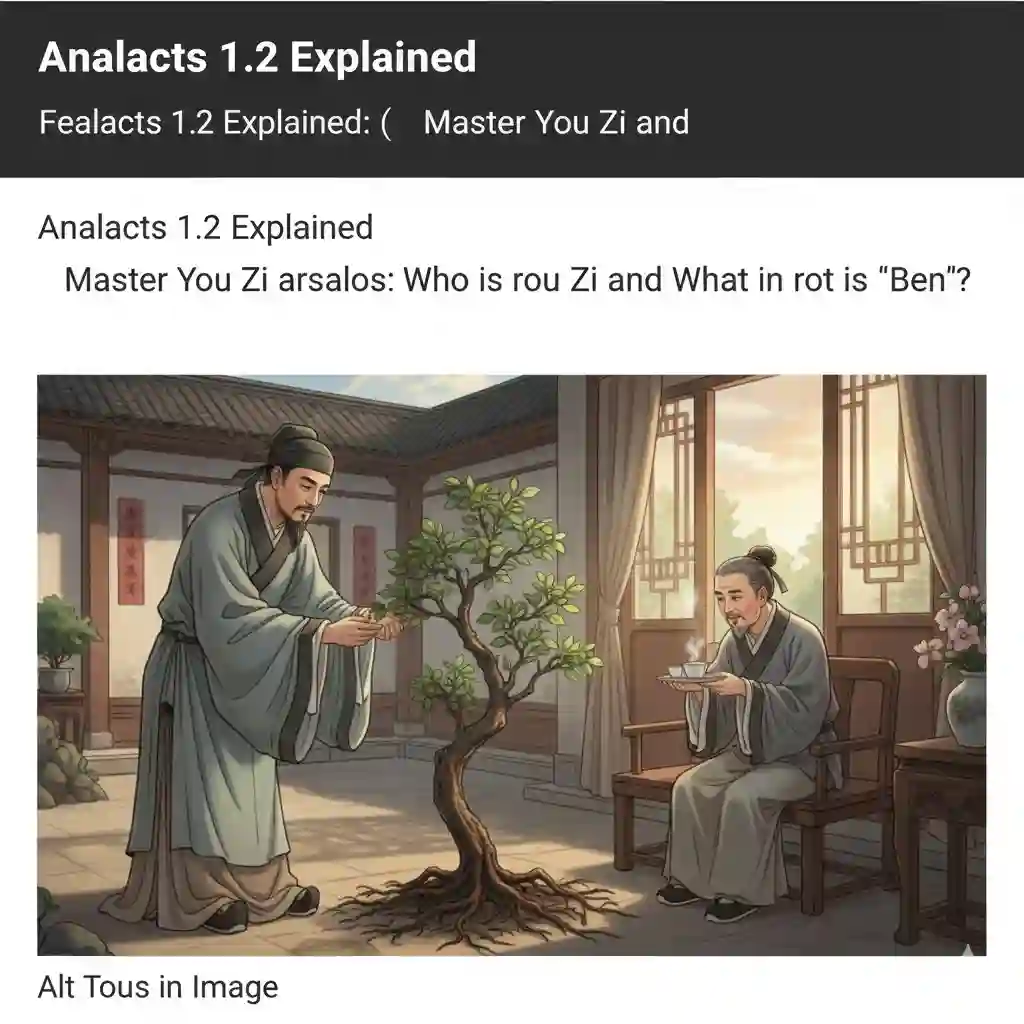
In this passage, Master You Zi introduces the concept of Xiao (Filial Piety) and Ti (Brotherly Love) as the “Ben” (本). Most people translate “Ben” as the “root” or the “core.” However, our Master provides a unique clarification: here, “Ben” means the starting point or the foundation, rather than the ultimate core of wisdom.
The Identity of You Zi (有子的身份)
You Zi (Master You) was 33 years younger than Confucius. He was one of the few disciples addressed as “Zi” (Master) in the Analects. This title was reserved for teachers or officials. Along with Master Zeng, Master Min, and Confucius himself, You Zi was a primary educator of the next generation of disciples. This academic authority gives his words significant weight in the structure of Confucian thought.
Starting Point vs. Core (起步与核心)
Master You Zi says, “The Junzi devotes himself to the Ben.” If spiritual cultivation is like building a skyscraper, filial piety is the first floor. It is the necessary starting point. You cannot reach the 100th floor (Wisdom/Ren) without building the first floor (Family Virtue). This is the “starting point” that allows the Dao (the Path) to emerge.
2. Two Critical Questions Regarding “Above” and Historical Accuracy
To master the logic of Analects 1.2 Explained: 5 Insights Why Master You Zi Calls Filial Piety the Starting Point of Virtue, we must answer these common questions.
Q1: What does “Shang” (上) represent? Is it just elders?
In the phrase “rare are those who are filial… yet fond of offending their superiors (Shang),” what does Shang mean? The Master explains that Shang is not just parents or elders; it represents Metaphysical Ethics and Rules. Since parents are our first teachers, if we respect them, we develop a sense of “order.” This order extends to social laws, ethical boundaries, and even traffic rules. A person who respects the “Shang” of their parents will naturally respect the “Shang” of the law.
Q2: Why is the age of You Zi disputed (33 vs. 43 years)?
The Records of the Grand Historian (Shiji) claims You Zi was 43 years younger than Confucius, but other records like the School Sayings of Confucius (Jiayu) say 33. The Master proves 33 is correct through historical logic. If You Zi were 43 years younger, he would have been only 10 years old when he was already a mature student participating in advanced mourning rituals. Therefore, 33 is the only logical age that fits the timeline of his apprenticeship.
3. The Benefits of Establishing the “Root” (Ben)
When you understand the framework of Analects 1.2 Explained: 5 Insights Why Master You Zi Calls Filial Piety the Starting Point of Virtue, you realize that social harmony starts at the dinner table.
- Social Stability: Those who are filial rarely “create chaos” (作乱). A stable family unit is the DNA of a stable nation.
- Legal Integrity: By respecting the hierarchy at home, one develops an internal compass for following laws and regulations.
- Path to Wisdom: “When the root is established, the Dao grows.” By perfecting the basics, the higher wisdom of Ren (Benevolence) becomes accessible.
- Consistency in Character: It prevents the hypocrisy of being “kind” to strangers while being cruel to one’s own parents.
| Benefit | Impact |
| Family Level | Peace and mutual respect among siblings and parents. |
| Social Level | Reduced crime and increased adherence to public rules. |
| Personal Level | A clear starting point for a life-long spiritual journey. |
4. Analects 1.2 Explained: Step-by-Step Path to Virtue
How do we practically apply these thousands-of-years-old teachings? Much like the ISO 9000 Standards
ensure quality in industrial systems, the Analects provides a standard for human quality.
Step 1: Start with the “Xiao” and “Ti”
Focus on the people you see every day. Are you patient with your parents? Do you support your siblings? This is the “First Floor” of your spiritual skyscraper. Without this, your “meditation” or “wisdom” is a castle in the air.
Step 2: Recognize the “Shang” (Rules)
Understand that rules exist above the individual. Whether it is a red light on the street or a law in the books, treat these as extensions of the respect you have for your first “superiors”—your parents.
Step 3: Practice “Wu Ben” (Focusing on the Root)
Instead of chasing high-minded philosophical “Ren” (仁) immediately, focus on the “Ben” (起步). Correct your behavior at home first. As we discussed in our previous post on Inner Strength and the Junzi, enlightenment is built upon the foundation of daily habit correction.
Step 4: Let the Dao Grow Naturally
Once the foundation is solid, you will find that “the Way” (Dao) begins to manifest. You won’t have to force yourself to be a good citizen; it will be a natural byproduct of your filial character.
Practical Results: The Transformation of a Junzi
Applying the teachings of Analects 1.2 Explained: 5 Insights Why Master You Zi Calls Filial Piety the Starting Point of Virtue leads to visible changes in one’s life:
- Diminished Conflict: You will find that your desire to “rebel” or “create chaos” in your social or professional circles diminishes because your heart is settled at home.
- Increased Social Trust: People naturally trust those who take care of their families. Your “Xiao” becomes your silent resume for reliability.
- Spiritual Clarity: By not “skipping steps,” you avoid the frustration of failed spiritual practices. You realize that enlightenment isn’t a secret formula—it’s a path that starts with a single step towards your parents.